Unlocking the Personality of AI: How Large Language Models Simulate Human Traits

Updated: Mar 10, 2025
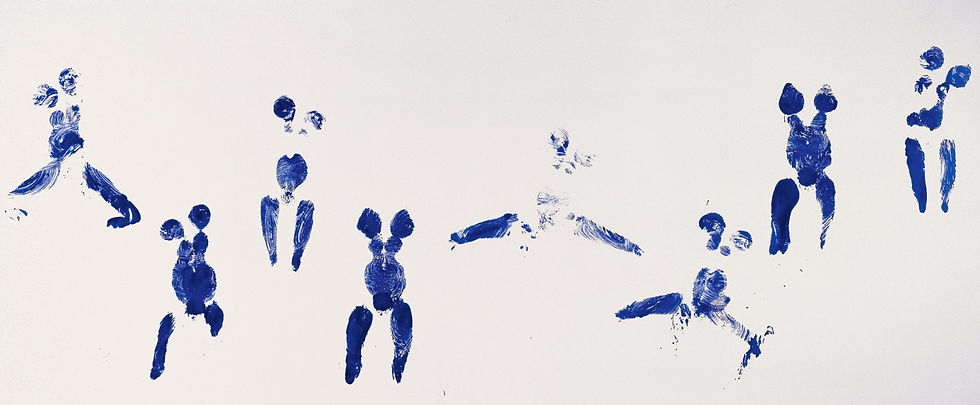
YVES KLEIN, UNTITLED ANTHROPOMETRY (ANT, 106), 1960
As artificial intelligence continues to transform industries, a new frontier is emerging: AI with personality. I want to share the results of research conducted by a group I was part of (Sorokovikova, A., Fedorova, N., Rezagholi, S., & Yamshchikov, I. P., 2024). In the study, LLMs Simulate Big Five Personality Traits: Further Evidence, we explored how advanced large language models (LLMs) such as GPT-4, Llama2, and Mixtral are capable of simulating the Big Five personality traits, potentially revolutionizing personalized human-computer interactions.
We analyzed LLMs for their ability to exhibit traits like conscientiousness, agreeableness, neuroticism, openness, and extraversion—key elements of the widely accepted Big Five personality model. By understanding how these traits are mirrored in AI behavior, developers can tailor interactions to specific user needs, whether in healthcare, education, or entertainment.
Why Personality Matters for AI
Imagine a healthcare assistant that exhibits empathy or a tutor that communicates with precision and clarity. These “personalities” enhance user experience by aligning the AI's language output with expected human traits. While LLMs like GPT-4 and Llama2 don’t possess emotions or consciousness, their outputs can be tailored to convey specific traits, impacting how users perceive them.
Findings: A Distinct Personality for Each Model
This study's groundbreaking findings reveal that each LLM displays distinct personality profiles:
GPT-4: Scores high in extraversion, making it ideal for creative and engaging communication. This positions it as a strong candidate for tasks that require dynamic interaction, such as content creation or customer engagement.
Llama2: Demonstrates a more neutral profile, with moderate scores across all traits. Its higher neuroticism suggests that it might be suitable for generating emotionally nuanced responses, which could enhance the realism of interactions in gaming or therapy applications.
Mixtral: With balanced traits, Mixtral is highly versatile. Its low neuroticism and high agreeableness make it a strong fit for tasks that require steady, emotionally balanced communication, such as virtual assistants or customer support.
Personalizing AI for Better Human Interaction
The ability to simulate personality traits opens doors for hyper-personalized user experiences. Whether it’s adapting to the preferences of individual users or fine-tuning AI behavior for different roles, the potential applications are vast. These insights help build AI that not only responds to human language but also mimics the subtle characteristics of human behavior, enhancing relatability and engagement.
The Future of AI Personalization
As this study demonstrates, personality simulation in AI is no longer a distant dream. It’s an evolving reality that has the potential to redefine industries by making human-computer interactions more personalized and effective. With continued research and development, future applications will unlock even more ways to tailor AI interactions, making them as dynamic and multifaceted as the humans they serve.
In the age of AI, personality might just be the next big thing. If you're interested in learning more, we warmly invite you to read the full publication by Sorokovikova, A., Fedorova, N., Rezagholi, S., & Yamshchikov, I. P. (2024), LLMs Simulate Big Five Personality Traits: Further Evidence.


Comments